
The Book of Psalms contains a remarkable series of “national” prophecies concerning the historical trajectory, survival, and restoration of the Jewish people. It is important to acknowledge that these scriptures often carry a wide range of scholarly interpretations; for example, theologians frequently differ on whether specific verses apply to the ancient return from Babylon, the modern State of Israel, or a future spiritual restoration. However, while there may be several valid interpretations for any individual prophecy, when they are viewed collectively, they become incredibly difficult to refute. From a purely mathematical or historical standpoint, the probability of all these distinct events occurring “naturally”—from the preservation of a landless identity to the revival of a dead language—is virtually astronomical. Taken together, these prophecies and the events that have unfolded over millennia provide compelling evidence that God has indeed preserved His people just as He declared He would thousands of years ago, making that preservation nearly impossible to deny in the historical record.
1. The Supernatural Preservation of the Jewish People
Prophecy (Psalm 121:4): “Behold, he that keepeth Israel shall neither slumber nor sleep.”
Approximate Date of Prophecy: c. 1000–500 BC
Estimated Fulfillment: Ongoing (Significant historical markers c. 70 AD – Present)
Evidence: Historically, no other ethnic group has maintained a distinct national, religious, and linguistic identity for nearly 2,000 years while being dispersed across the globe without a sovereign homeland. Historians like Arnold Toynbee have noted that the survival of the Jewish people defies the standard “laws of history” that saw the assimilation and disappearance of other ancient contemporaries like the Moabites, Edomites, or Philistines. Despite the Roman destruction in 70 AD, the Crusades, the Inquisition, and the Holocaust, the Jewish people remained a cohesive entity—a feat unparalleled in human sociology.
2. The Global Gathering of the Exiles
Prophecy (Psalm 107:2-3): “Let the redeemed of the LORD say so… and gathered them out of the lands, from the east, and from the west, from the north, and from the south.”
Approximate Date of Prophecy: c. 5th Century BC
Estimated Fulfillment: c. 1880s – Present (The modern Aliyah movements)
Evidence: The 20th-century phenomenon known as “Aliyah” has seen the return of millions of Jewish people to their ancestral land from over 100 different nations. This includes documented mass migrations such as “Operation Magic Carpet” (Yemen), “Operation Solomon” (Ethiopia), and the massive influx from the former Soviet Union. This gathering is unique because it involved people from vastly different cultures and languages all identifying with a single ancestral home, literally fulfilling the gathering from the “four corners” of the earth.
3. The Perpetual Conflict with Surrounding Nations
Prophecy (Psalm 83:4): “They have said, Come, and let us cut them off from being a nation; that the name of Israel may be no more in remembrance.”
Approximate Date of Prophecy: c. 1000 BC (Asaph the Seer)
Estimated Fulfillment: c. 1948 – Present
Evidence: The specific rhetoric used in this Psalm—the goal of total eradication rather than mere territorial conquest—is documented in the modern era. Historical records from the 1948, 1967, and 1973 regional conflicts show that the stated objective of the opposing coalitions frequently mirrored this exact “cutting off from being a nation” language. The 1948 Arab-Israeli War, for instance, saw five nations invade with the explicit intent of preventing the birth of the Israeli state, echoing the ancient psalmist’s warning of a multi-national conspiracy.
4. The Transformation of the Wilderness
Prophecy (Psalm 107:35): “He turneth the wilderness into a standing water, and dry ground into watersprings.”
Approximate Date of Prophecy: c. 5th Century BC
Estimated Fulfillment: c. 1900 – Present
Evidence: At the beginning of the 20th century, much of the Holy Land was documented as “desolate” and “unlovely.” Today, through advanced irrigation and desalination, the Negev desert has become a global center for agriculture. This transformation is so stark that pilots and astronauts have noted that the green borders of Israel are clearly visible from the air, creating a sharp contrast against the brown, arid landscapes of the surrounding regions. Israel is one of the few countries in the world that ended the 20th century with more trees than it had at the beginning, thanks to the planting of over 250 million trees by the JNF and other organizations.
5. The Restoration of the Hebrew Language
Prophecy (Psalm 81:5): “…where I heard a language that I understood not.”
Approximate Date of Prophecy: c. 1000 BC
Estimated Fulfillment: c. 1881 – 1948 (The revival led by Eliezer Ben-Yehuda)
Evidence: The revival of Modern Hebrew is considered a linguistic miracle. For nearly 2,000 years, Hebrew was a “dead” language used only for liturgy, much like Latin. Through the work of Eliezer Ben-Yehuda and the subsequent national restoration, it is now the primary spoken language of millions. This is the only documented case in history of a sacred language being successfully revived as a national vernacular, defying the linguistic norm that once a language ceases to be a mother tongue, it never returns to daily use.
6. The Witness of the “Scattered” People
Prophecy (Psalm 59:11): “Slay them not, lest my people forget: scatter them by thy power; and bring them down, O Lord our shield.”
Approximate Date of Prophecy: c. 1000 BC
Estimated Fulfillment: c. 70 AD – Present (The Great Diaspora)
Evidence: This Psalm speaks of a “scattering” that serves as a witness. Historically, the Jewish Diaspora (the *Galut*) saw the Jewish people spread into every corner of the Roman Empire and beyond. Rather than being “slain” (extinguished), their presence in every nation served as a historical witness to the biblical narrative. This “witness people” concept was even noted by early church fathers like Augustine, who argued that the Jewish people’s survival in dispersion was a living testimony to the truth of the scriptures they carried.
7. The Joyful Return to Zion
Prophecy (Psalm 126:1-2): “When the LORD turned again the captivity of Zion… Then was our mouth filled with laughter, and our tongue with singing.”
Approximate Date of Prophecy: c. 5th Century BC
Estimated Fulfillment: c. 1948 (Establishment of the State of Israel)
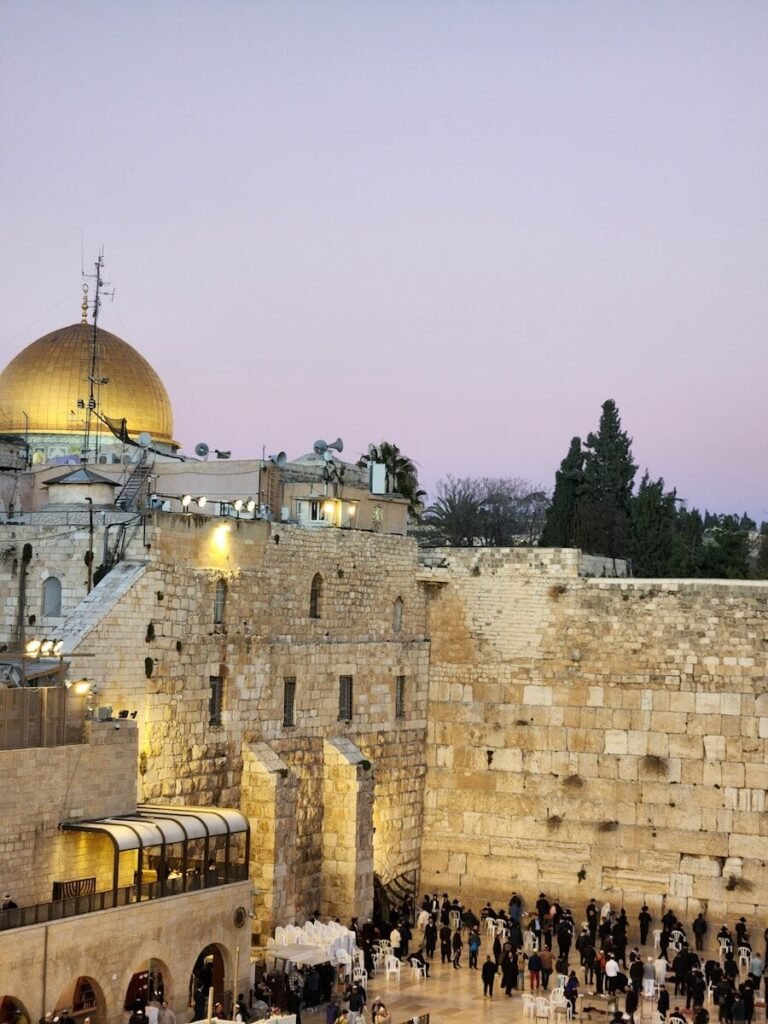
Evidence: The historical return from the Babylonian captivity and the modern return to Zion are marked by a unique cultural and national “re-awakening.” The restoration of Jewish sovereignty in 1948 AD led to a global cultural shift in Jewish music, art, and national identity. The specific “laughter and singing” mentioned by the psalmist is reflected in the vibrant cultural explosion of the modern state, where Hebrew poetry and song have flourished after centuries of mourning in exile.
Related Articles: Twelve Prophecies about Jesus in the Book of Psalms, What are Messianic Psalms?