
The destruction of the Second Temple in 70 AD stands as one of the most significant events in human history, marking the literal fulfillment of Jesus Christ’s specific predictions. While the Romans were the physical agents of this destruction, the event was mathematically and prophetically scheduled centuries in advance. To see how this fits into the larger timeline, read our post on The Prophecy of the 70 Weeks.
The Disciples’ Admiration and Jesus’ Warning
As Jesus was leaving the Temple for the final time, His disciples were struck by the grandeur of the structure. Herod’s Temple was renowned as one of the wonders of the ancient world, adorned with massive white stones and gold. The account in Mark 13:1-2 (KJV) records the exchange:
“And as he went out of the temple, one of his disciples saith unto him, Master, see what manner of stones and what buildings are here! And Jesus answering said unto him, Seest thou these great buildings? there shall not be left one stone upon another, that shall not be thrown down.”
This warning was staggering because some of the stones in the Temple complex weighed over 500 tons. To the disciples, the idea of these massive blocks being “thrown down” seemed physically impossible without divine intervention or total catastrophe.
The Prophetic Requirement (Daniel 9:26)
This destruction was not merely a reaction to a Jewish revolt; it was a prophetic necessity. Daniel had predicted that after the Messiah was “cut off,” the city and the sanctuary would be destroyed. Daniel 9:26 (KJV) states:
“…and the people of the prince that shall come shall destroy the city and the sanctuary; and the end thereof shall be with a flood, and unto the end of the war desolations are determined.”
The Historical Fulfillment: 70 AD
In 66 AD, a Jewish revolt led to a Roman siege of Jerusalem. By 70 AD, the Roman legions under Titus breached the walls. According to the Jewish historian Flavius Josephus in The Wars of the Jews, Titus actually held a council of war and expressed a desire to preserve the Temple as an ornament of the Roman Empire. However, Josephus records that during the heat of battle, a soldier—acting without orders—threw a firebrand into the sanctuary.
The resulting inferno was so intense that it melted the gold leaf covering the Temple’s interior. As the liquid gold ran into the crevices between the massive stones, Roman soldiers later pried every single stone apart to recover the wealth. This systematic dismantling, driven by greed, literally fulfilled Jesus’ prophecy that “not one stone shall be left upon another.” While some historians debate Josephus’ portrayal of Titus as a “reluctant” destroyer, the physical result remains an undeniable historical fact.
Archaeological Evidence: The “Trumpeting Place” Stone
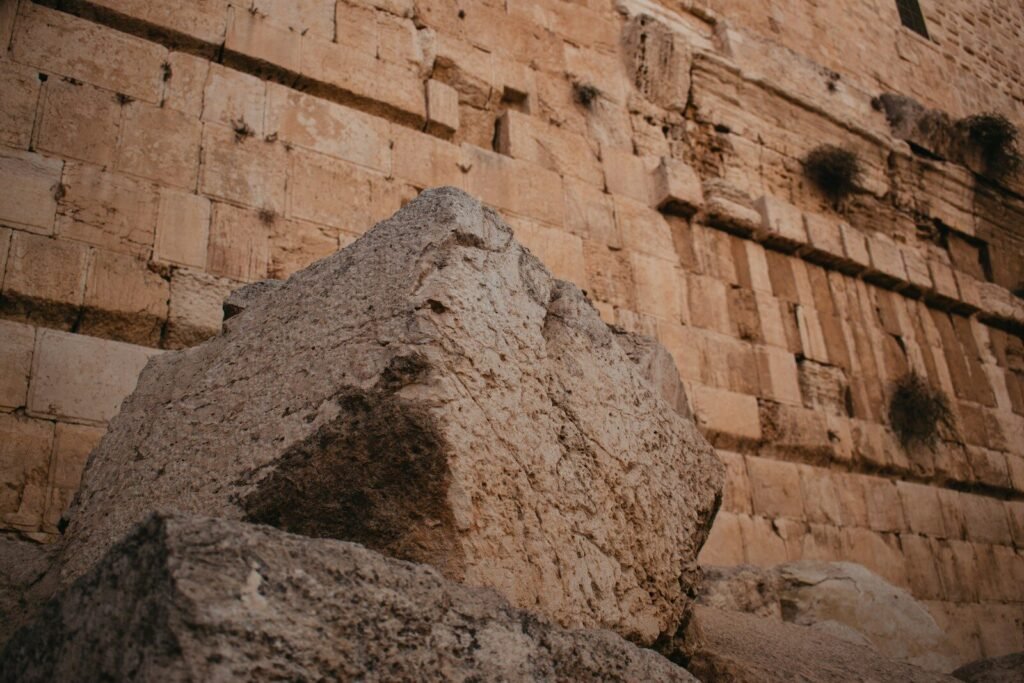
In 1968, archaeologist Benjamin Mazar discovered a unique artifact that provides undeniable proof of the Temple’s systematic dismantling. Known as the “Trumpeting Place Stone,” this massive block was found lying on the Herodian street at the foot of the southwest corner of the Temple Mount. It is a large, hewn cornerstone featuring a distinct niche where a priest would stand, and it bears a clear Hebrew inscription: “L’beit hatkiya l’hakhal”—translated as “To the place of trumpeting to [declare/distinguish].”
The significance of this single stone cannot be overstated:
- The Highest Point: This stone originally sat at the very pinnacle (the “pinnacle of the Temple”) of the southwest corner. It was the highest point of the sanctuary walls, overlooking the city and the markets below.
- The Priest’s Signal: From this exact stone, a priest would blow the shofar (ram’s horn) every Friday evening to signal the beginning of the Sabbath and again on Saturday evening to signal its end. It was the “voice” of the Temple to the people of Jerusalem.
- Literal Fulfillment: The fact that this specific stone—the very highest point of the structure—was found cast down onto the pavement below is a staggering confirmation of Jesus’ words. For this stone to be on the street, Roman soldiers had to intentionally pry it loose and heave it off the top of the wall. It didn’t just fall; it was “thrown down.”
- A Silent Witness: While most of the Temple stones were reused in later centuries for other buildings, this stone was left where it fell, buried by the rubble of the other “thrown down” blocks until its discovery nearly 1,900 years later.
Why This Silences Critics
The precision of this prophecy silences critics who claim the Bible is merely a collection of vague religious writings. Jesus predicted the total dismantling of the Temple at a time when it was one of the most stable structures in the world. Furthermore, the fact that the destruction happened after the Messiah was “cut off” (crucified) but before the end of the age aligns perfectly with the timeline in Daniel 9. The discovery of the “Trumpeting Place” stone proves that the destruction was not just a fire, but a physical dismantling where even the highest cornerstones were cast down exactly as Jesus described.
Historical and Secular References
- Flavius Josephus, *The Wars of the Jews*: The primary source for the account of Titus’ war council and the soldier’s firebrand.
- The Arch of Titus (Rome): A victory arch depicting Roman soldiers carrying away the Menorah and other Temple treasures as spoils of war.
- The Israel Museum: Where the original “Trumpeting Place” stone is currently housed as a historical artifact of the 70 AD destruction.
- Matthew 24:1-2: The parallel account of Jesus’ prophecy regarding the total dismantling of the Temple complex.