
Major Theme: The “Fullness of Time”—how the Roman Empire unwittingly provided the exact historical and sociological conditions required for the rapid, global explosion of the Gospel.
Scripture Foundation: Galatians 4:4, Isaiah 40:3-5.
Editor’s Note: In our previous installments, we explored the cosmic and biological improbabilities of our existence, followed by the structural survival of ancient Judaism. Now we move into the “fullness of time”—the precise historical moment when the Roman world provided the physical and cultural hardware necessary for a local Messianic movement to become a global revolution.
1. The Pax Romana: The Unnatural Peace
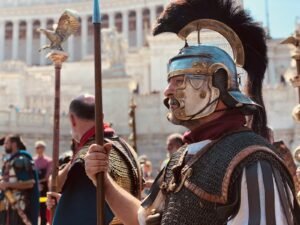
Background: For most of human history, travel was a death sentence. To move between regions meant crossing borders of warring tribes, facing local bandits, and navigating shifting political allegiances. However, the Pax Romana (Roman Peace) created a unique, 200-year window of relative stability across the Mediterranean. By subduing local conflicts and clearing the seas of pirates, Rome inadvertently created a “borderless” world. This was a historical anomaly; never before had such a vast, diverse territory been so safe for the movement of common people and radical ideas.
Scripture Connection:
“But when the fulness of the time was come, God sent forth his Son…” (Galatians 4:4, KJV)
“And his name shall be called… The Prince of Peace.” (Isaiah 9:6, KJV)
Results: This stability allowed the first missionaries to travel thousands of miles without an army. Without the Roman Peace, the Gospel would likely have remained a local movement, unable to cross the hostile borders of competing kingdoms. Rome provided the physical safety that Jesus, the “Prince of Peace,” utilized to spread a different, spiritual peace. It is a historical irony: the Roman Empire spent centuries building a world of order through military force, only for that very order to be used to spread the message of Christ across the globe.
2. The Roman Road System: The Ancient Internet

Background: Rome constructed over 50,000 miles of paved, high-quality roads. While built for the rapid deployment of legions to crush rebellions, these roads became the “fiber-optic cables” of the ancient world. They were straight, drained, and marked with milestones, connecting the furthest reaches of the Empire to the capital. This infrastructure allowed for a speed of communication that was technically impossible just a century prior. The Gospel did not have to hack its way through the wilderness; it traveled on the finest highway system the world had ever seen.
Scripture Connection:
“The voice of him that crieth in the wilderness, Prepare ye the way of the Lord, make straight in the desert a highway for our God.” (Isaiah 40:3, KJV)
“Go out into the highways and hedges, and compel them to come in…” (Luke 14:23, KJV)
Results: These roads enabled the rapid “viral” spread of the faith. A letter written in Ephesus could reach Rome in weeks rather than months. The physical connectivity of the Empire was the essential hardware that allowed the software of the New Testament to be installed across three continents in a single generation.
3. Koine Greek: The Universal Language
Background: Before the Roman era, the Mediterranean was a tower of Babel—a chaotic mix of local dialects. However, the conquests of Alexander the Great followed by Roman administration established Koine (Common) Greek as the universal language of trade and philosophy. For the first time in history, a man from Judea could speak to a man in Rome or North Africa and be perfectly understood. The New Testament was not written in a “sacred” priestly language, but in the “street Greek” of the marketplace.
Scripture Connection:
“And how hear we every man in our own tongue, wherein we were born?” (Acts 2:8, KJV)
“And that every tongue should confess that Jesus Christ is Lord…” (Philippians 2:11, KJV)
Results: This linguistic unity prevented the Gospel from being “lost in translation” during its most critical years. It allowed for the immediate distribution of complex theological concepts (like Logos or Grace) to a massive, diverse audience without the need for a thousand different translators.
4. The Jewish Diaspora: Pre-Built Launchpads
Background: Centuries of exile and trade had scattered Jewish communities into every major Roman city. These Diaspora Jews had already done the “heavy lifting” of introducing monotheism and the Old Testament to the pagan world. In every city, there was already a synagogue—a ready-made platform with a built-in audience familiar with the Messianic prophecies. Paul didn’t have to start from scratch; he had a network of “embassies” waiting for him.
Scripture Connection:
“For Moses of old time hath in every city them that preach him, being read in the synagogues every sabbath day.” (Acts 15:21, KJV)
“And he went into the synagogue, and spake boldly for the space of three months…” (Acts 19:8, KJV)
Results: This provided the early Church with an immediate, high-trust network. The synagogues acted as the “hubs” in a hub-and-spoke model of expansion, allowing the faith to take root in urban centers simultaneously rather than trickling out slowly from a single point.
5. The “God-Fearers”: The Bridge People
Background: Within the Roman world, a growing class of Gentiles known as “God-Fearers” were attracted to the high morality and monotheism of Judaism but were hesitant to fully convert due to the complex ritual laws. They were a people in waiting—spiritually hungry but culturally stuck. Christianity offered them exactly what they sought: the God of Israel without the ethnic barriers. They became the primary bridge through which the faith crossed from a Jewish context into the wider Roman world.
Scripture Connection:
“Men and brethren, children of the stock of Abraham, and whosoever among you feareth God, to you is the word of this salvation sent.” (Acts 13:26, KJV)
“There was a certain man in Caesarea called Cornelius… A devout man, and one that feared God…” (Acts 10:1-2, KJV)
Results: The existence of this specific demographic was a sociological “key” that unlocked the Roman Empire. They provided the early Church with its first Greek-speaking leaders and financial supporters, acting as the catalyst for the faith’s transition from a national movement to a universal one.
6. The Failure of Paganism: The Spiritual Vacuum
Background: By the first century, the old Roman and Greek pantheons were in a state of terminal decay. The gods of Olympus had become literary characters rather than objects of genuine faith. Roman state religion was increasingly seen as a hollow political duty. This created a massive spiritual vacuum—a “hunger for the holy” that the cold philosophies of Stoicism or the chaotic mystery cults could not satisfy. The world was spiritually “primed” for a faith that offered personal relationship, moral clarity, and historical certainty.
Scripture Connection:
“For as I passed by, and beheld your devotions, I found an altar with this inscription, TO THE UNKNOWN GOD. Whom therefore ye ignorantly worship, him declare I unto you.” (Acts 17:23, KJV)
“Ho, every one that thirsteth, come ye to the waters…” (Isaiah 55:1, KJV)
Results: This vacuum ensured that the Gospel didn’t just compete with other religions; it filled an empty space. The rapid conversion of the Roman world was not just a matter of persuasion, but of providing water to a civilization that was dying of thirst. The “improbability” lies in the fact that the Gospel arrived at the exact moment the old world’s heart stopped beating.
The Precision of the Window
If the arrival of the Messiah had occurred five centuries earlier, the message would have been trapped behind the impenetrable borders of warring city-states and silenced by a thousand local dialects. If it had occurred five centuries later, the Roman infrastructure would have been in ruins, the roads reclaimed by the wilderness, and the Mediterranean fractured by the collapse of central authority. There was a narrow, high-precision window in human history where the world was physically connected, linguistically unified, and spiritually exhausted.
This convergence of roads, laws, and language was not a historical accident, but the assembly of a global stage. The Roman Empire spent centuries building the very machinery that would eventually facilitate the spread of a message that transcended its own pagan foundations. It was the moment in history that perfectly fulfilled the divine schedule: “But when the fulness of the time was come, God sent forth his Son, made of a woman, made under the law” (Galatians 4:4, KJV).
The “Fullness of Time” was a sociological eye of the needle. The hardware was installed, the network was live, and the audience was waiting. The infrastructure of providence was complete, and the world was now ready for the entrance of the One for whom the stage had been set.
Deepening the Case: With the cosmic, biological, and historical stages now fully set, we move from the infrastructure to the Individual. In our next installment, we examine the ultimate anomaly of history: the Person of Jesus Himself. Read Part 16 here: The Eye of the Needle: The Messiah No One Expected (Part 16)
Visualizing the Evidence
Watch these presentations that explore the improbable timing and convergence of historical factors in the “Fullness of Time”:
The Pax Romana, The Roman Road System, and Koine Greek
The Jewish Diaspora: Pre-Built Launchpads
Sources and Further Reading:
- The Holy Bible (King James Version).
- Bruce, F.F. The Spreading Flame: The Rise and Progress of Christianity from its First Beginnings to the Conversion of the English. Eerdmans.
- Ferguson, Everett. Backgrounds of Early Christianity. Eerdmans.
- MacMullen, Ramsay. Christianizing the Roman Empire: (A.D. 100-400). Yale University Press.
- Stark, Rodney. The Rise of Christianity: How the Obscure, Marginal Jesus Movement Became the Dominant Religious Force in the Western World in a Few Centuries. Princeton University Press.
- Wright, N.T. The New Testament and the People of God. Fortress Press.