
Major Theme: The Intelligent Design and Fine-Tuning of the Universe (Part 4).
Scripture Foundation: Psalm 19:1, Isaiah 40:12, Colossians 1:17, Hebrews 11:3.
Editor’s Note: This post is the fourth installment in our series on cosmic fine-tuning. Here, we examine six additional factors that further reveal the razor-thin precision required for our universe to exist. Some references to spans of time are not Biblical, but even if you take them at face value, they STILL point to God.
The following six items continue the evidence for fine-tuning. Each factor, if altered even slightly, would render the universe unfit for life or stable matter.
1. The Average Density of the Universe (The Cosmic Geometry)

Background: The total amount of matter and energy in the universe determines its overall geometry and ultimate fate. This density must be balanced against the expansion rate of space. If the universe has a “flat” geometry, it means the density is exactly at the critical value required to allow for the formation of large-scale structures over billions of years.
Scripture Connection: “Who hath… weighed the mountains in scales, and the hills in a balance?” (Isaiah 40:12)
Possible Results: If the average density were even slightly higher (by one part in 10^60), the universe would have reached a “Big Crunch” and collapsed back into a singularity almost immediately after its beginning. If it were even slightly lower, the expansion would have been so dominant that matter would have dispersed too quickly to ever coalesce into stars, galaxies, or planets. In either case, the universe would be a barren void.
2. The Unique Density of Frozen Water (The Hydrogen Bond)

Background: Water is a rare and profound exception to the laws of thermal physics. While almost every other liquid becomes more dense and contracts when it freezes, water molecules utilize “hydrogen bonding” to form a rigid, open crystalline lattice as they reach the freezing point. This is made possible because water molecules have a unique “bent” shape, which forces them into a specific geometric architecture as they cool. This structure actually pushes the molecules further apart, causing water to expand and become less dense as a solid than as a liquid.
Scripture Connection: “For he saith to the snow, Be thou on the earth; likewise to the small rain, and to the great rain of his strength.” (Job 37:6)
Possible Results: If water behaved like other liquids and contracted upon freezing, ice would sink to the bottom of lakes and oceans. These bodies of water would freeze from the bottom up, eventually turning into solid blocks of ice that the sun could never fully thaw. This would not only destroy all aquatic life but would also disrupt the global climate so severely that the Earth would become a permanent, frozen wasteland, incapable of supporting any form of complex life.
3. The Stability of the Proton (The Enduring Matter)
Background: Protons appear to be extraordinarily stable, with a half-life estimated to be vastly longer than the age of the universe itself. This stability ensures that the atoms making up our bodies, the Earth, and the stars do not simply evaporate or decay into radiation over time. It is the fundamental reason matter persists.
Scripture Connection: “Of old hast thou laid the foundation of the earth: and the heavens are the work of thy hands. They shall perish, but thou shalt endure…” (Psalm 102:25-26)
Possible Results: If protons decayed significantly more quickly, all matter in the universe would slowly transform into radiation. Biological organisms would be destroyed from the inside out by the internal radiation of their own atoms. Over time, the universe would lose all its solid structures, leaving behind nothing but a thin, uniform mist of subatomic particles and light.
4. The Velocity of Light (The Universal Speed Limit)
Background: The speed of light (c) is a fundamental constant tied into the very fabric of space and time. It dictates the relationship between energy and mass (E=mc²) and governs the strength of electromagnetic fields. It is the “speed limit” of the universe that ensures causality—that causes always precede effects.
Scripture Connection: “And God said, Let there be light: and there was light.” (Genesis 1:3)
Possible Results: If the speed of light were significantly different, the energy output of stars would be radically altered. If it were faster, stars would burn much hotter and brighter, likely scouring nearby planets of any life. If it were slower, stars would be too dim and cold to provide the energy necessary for photosynthesis or to keep planets warm enough for liquid water. Life as we know it would be impossible.
5. Magnitude of CMB Fluctuations (Q) (The Galactic Seeds)
Background: The Cosmic Microwave Background (CMB) contains tiny ripples in density, represented by the value Q (roughly 1 in 100,000). These ripples provided the gravitational “seeds” that allowed gas to clump together in the early universe, eventually forming the first stars and galaxies.
Scripture Connection: “The heavens declare the glory of God; and the firmament sheweth his handywork.” (Psalm 19:1)
Possible Results: If Q were smaller (e.g., 1 in 1,000,000), gravity would have been too weak to pull gas together, and the universe would have remained a cold, featureless cloud of hydrogen and helium. If Q were larger (e.g., 1 in 10,000), the fluctuations would have been so violent that the universe would be filled with massive black holes instead of stable galaxies and stars.
6. Distance Between Stars and Galaxies (The Safe Harbor)
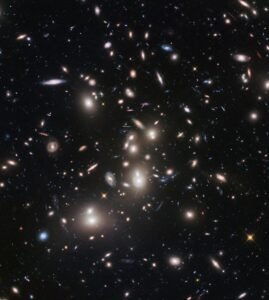
Background: The average spacing between stars (about 30 trillion miles in our neighborhood) is critical for planetary stability. This distance is determined by the density of matter and the rate of expansion. It allows for the distribution of heavy elements through supernovae without those same events destroying nearby solar systems.
Scripture Connection: “He telleth the number of the stars; he calleth them all by their names.” (Psalm 147:4)
Possible Results: If stars were significantly closer, gravitational interactions between passing stars would frequently strip planets from their stable orbits, sending them into the freezing void. If they were significantly further apart, the heavy elements produced in the deaths of old stars would never reach other gas clouds to form new solar systems with rocky planets like Earth.
Deepening the Case: In Part 5, we will examine the “Perfect Neighborhood”—the specific requirements for our galaxy, the Milky Way, to support life. Read Part 5 here: The Eye of the Needle: The Galactic Neighborhood (Part 5)
Visualizing the Evidence
Watch this secular video that explains the unique properties of water.
The Unique Density of Frozen Water
Sources
- Barrow, J. D., & Tipler, F. J. (1986). The Anthropic Cosmological Principle. Oxford University Press.
- Collins, R. (2003). The Evidence for Fine-Tuning. In God and Design: The Teleological Argument and Modern Science. Routledge.
- Denton, M. J. (1998). Nature’s Destiny: How the Laws of Biology Reveal Purpose in the Universe. Free Press.
- Gonzalez, G., & Richards, J. W. (2004). The Privileged Planet: How Our Place in the Cosmos is Designed for Discovery. Regnery Publishing.
- Ross, H. (2008). Why the Universe Is the Way It Is. Baker Books.