
Major Theme: The Narrow Gate of Survival—how the Church (the body of Christ) navigated internal crises, doctrinal battles, and corruption, yet endured where other movements fractured or faded. This post bridges historical challenges to the ongoing resilience of faith today.
Scripture Foundation: John 17:20-23, 1 Corinthians 1:10.
Editor’s Note: This installment explores the remarkable unity and endurance of the Church in the face of internal division, theological controversy, and institutional corruption. We distinguish between the Catholic Church as an institution and the wider body of Christ. The focus is on how the Christian faith persisted—and often thrived—despite obstacles that have shattered other religious movements.
1. The Battle for Orthodoxy: Surviving Heresy
Background: From Gnosticism to Arianism, the early Church (body of Christ) faced doctrinal threats that could have torn it apart. It is a historical anomaly that despite no central authority for centuries, the core message of Christ’s divinity and the Gospel remained intact. Councils like Nicaea were not just meetings—they were pivotal moments of unity against fragmentation.
Scripture Connection: “That they all may be one; as thou, Father, art in me, and I in thee, that they also may be one in us: that the world may believe that thou hast sent me.” (John 17:21, KJV)
Results: The Church (body of Christ) maintained a recognizable orthodoxy that survived the collapse of the Roman Empire and the rise of competing philosophies. While movements like Gnosticism faded into obscurity or splintered into unrecognizable sects, the core tenets of the faith remained anchored in the Word, ensuring a unified witness for future generations.
2. The Scandal of Power: Surviving Institutional Corruption
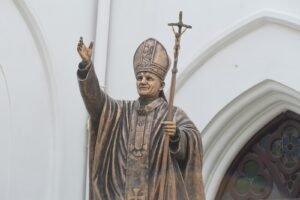
Background: The rise of the Catholic Church as a dominant institution brought immense power—and with it, deep-seated corruption. From the sale of indulgences to the moral failures of popes, the wonder is that the Gospel message survived and continued to transform lives, even when the institution itself was compromised.
Scripture Connection: “Upon this rock I will build my church; and the gates of hell shall not prevail against it.” (Matthew 16:18, KJV)
Results: Reform movements, most notably the Reformation, arose as a self-correcting mechanism within the faith. This allowed the body of Christ to persist and flourish outside of compromised institutional boundaries. Unlike other religious systems where systemic corruption often led to total societal and spiritual collapse, the Christian faith demonstrated a unique ability to return to its biblical foundations and experience renewal.
3. The Resilience of Unity: Surviving Schism
Background: The Church has endured countless schisms—East vs. West, Protestant vs. Catholic, denominational splits. Yet, the core faith and message remain globally recognizable. In contrast, religions like Buddhism and Islam have fractured into sects so divergent they sometimes barely recognize each other.
Scripture Connection: “Now I beseech you… that ye be perfectly joined together in the same mind and in the same judgment.” (1 Corinthians 1:10, KJV)
Results: While schisms have led to vastly different doctrines regarding salvation, the body of Christ has maintained a coherent identity through a shared reliance on the same Scriptures. Even when institutional traditions added requirements to the Gospel, the “Faith Alone” message has continually resurfaced through renewal movements, proving that the core biblical truth cannot be permanently buried by denominational or institutional shifts.
4. The Survival of Witness: Persecution from Within
Background: Not all persecution came from outside. Throughout history, Christians have suffered at the hands of other Christians—Inquisition, forced conversions, and suppression of dissent. It is striking that genuine faith endured and spread, even when the institution tried to silence it.
Scripture Connection: “Blessed are ye, when men shall revile you, and persecute you, and shall say all manner of evil against you falsely, for my sake.” (Matthew 5:11, KJV)
Results: The witness of the faithful who stood against internal tyranny often served as the catalyst for major spiritual revivals. This endurance proved that the Holy Spirit operates independently of human political structures. While internal persecution in other religious groups often led to stagnation or the complete silencing of truth, in Christianity, it frequently refined the faith and led to its further expansion.
The Narrow Gate of Survival
The survival of the Church (the body of Christ) through centuries of internal conflict, corruption, and division is a story of passing through the eye of the needle. When we look at the historical “norm” for major religious movements, the result is almost always permanent, irreconcilable fragmentation. Christianity’s unique path is not that it avoided these deep divisions, but that it survived them while maintaining a globally recognizable core message centered on the authority of Christ.
This endurance suggests that the ‘software’ of the Gospel message is not dependent on the perfection of its human institutions. Even when the Catholic Church faced its darkest periods of institutional corruption or when schisms threatened to tear the fabric of the faith, the body of Christ persisted. It proved that the Gospel is a trans-cultural, self-correcting force capable of surviving its own success and its own failures. By continually returning to its biblical roots, the faith remains uniquely equipped to face the challenges of the modern age.
Deepening the Case: We have seen how the faith survived the narrow gate of internal trial and division. But the story of Christianity is not just one of survival; it is one of universal reach. In our next installment, we examine how this ancient movement crossed every geographic and cultural boundary to become a truly global faith. Read Part 21 here: The Eye of the Needle: Faith Without Borders (Part 21)
Visualizing the Evidence
Watch these presentations that explore the resilience and survival of the faith through internal challenges:
The Battle for Orthodoxy: Arianism Explained
(Note: This video is from a Catholic source; while we agree with the views represented in this video, we do not agree with many Catholic doctrines)
The Scandal of Power: The Dark Ages of the Church
(Note: The word “Church” used in this video is almost always referencing the Catholic Church)
The Resilience of Unity: The Protestant Reformation
The Survival of Witness: The Inquisition
Sources and Further Reading:
- The Holy Bible (King James Version).
- MacCulloch, Diarmaid. Christianity: The First Three Thousand Years. Penguin.
- Pelikan, Jaroslav. The Christian Tradition. Yale University Press.
- Jenkins, Philip. The Lost History of Christianity. HarperOne.
- Armstrong, Karen. A History of God. Ballantine.
- Stark, Rodney. The Triumph of Christianity. HarperOne.