
Major Theme: The Precision Architecture of the Solar System (Part 7).
Scripture Foundation: Job 38:4-7, Isaiah 45:18, Psalm 147:4.
Editor’s Note: Beyond the Sun itself, the arrangement of the planets in our Solar System reveals a staggering level of intentionality. From gravitational “shields” to the isolation of our star, every component is positioned to ensure the long-term stability of the inner rocky worlds.
1. The “Jupiter Shield” (Gravitational Vacuum)
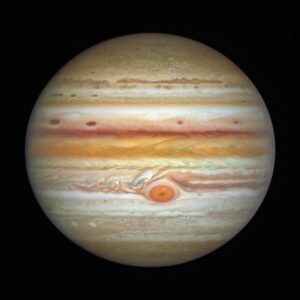
Background: Jupiter is more massive than all other planets in the Solar System combined. Its immense gravity acts as a cosmic “vacuum cleaner,” attracting and redirecting long-period comets and asteroids that would otherwise plunge into the inner Solar System. Without Jupiter’s specific mass and placement, Earth would likely experience catastrophic impacts at a rate 1,000 to 10,000 times higher than what we observe today.
Scripture Connection: “He shall cover thee with his feathers, and under his wings shalt thou trust…” (Psalm 91:4)
Possible Results: Without this giant guardian, the inner Solar System would be a shooting gallery. Frequent “extinction-level” impacts would prevent the development of complex life or stable civilizations. Jupiter’s placement is a literal shield for our existence.
2. Saturn’s Balancing Act (The Grand Tack)
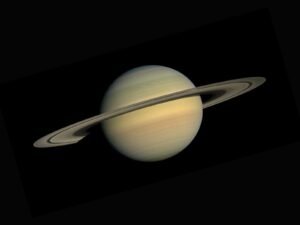
Background: Modern planetary science suggests that in the early Solar System, Jupiter began migrating inward toward the Sun, a process that would have destroyed the inner rocky planets. However, the formation of Saturn created a gravitational “tug-of-war” that pulled Jupiter back to its current, stable orbit. This “Grand Tack” maneuver is a highly improbable event that saved the inner Solar System from destruction.
Scripture Connection: “Who shut up the sea with doors… and said, Hitherto shalt thou come, but no further: and here shall thy proud waves be stayed?” (Job 38:8-11)
Possible Results: If Saturn were smaller or formed later, Jupiter would have continued its inward trek, either swallowing the Earth or flinging it into deep space. Saturn’s mass was perfectly timed and weighted to “stay” Jupiter’s path.
3. Planetary Spacing and Circularity
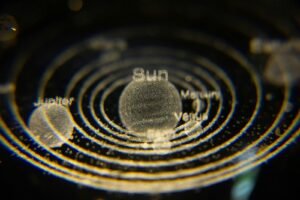
Background: When we look at other star systems, we typically see planets in highly elliptical (oval-shaped) orbits that cross paths and create gravitational chaos. In contrast, our planets maintain remarkably stable, nearly circular orbits with wide spacing. This “clockwork” regularity prevents planets from tugging each other out of their habitable zones over time.
Scripture Connection: “The Lord by wisdom hath founded the earth; by understanding hath he established the heavens.” (Proverbs 3:19)
Possible Results: Elliptical orbits cause extreme seasonal temperature swings and gravitational instability. Our system’s circularity is an “established” order that allows for the long-term climatic stability required for life.
4. The “Clearance” of the System
Background: The Solar System is unusually “clean” of debris compared to the dusty disks observed around other stars. This is likely due to the specific migration history of our gas giants, which cleared out the excess rock and ice during the system’s formation. This leaves the inner planets in a relatively safe, low-impact environment.
Scripture Connection: “Thou madest him to have dominion over the works of thy hands; thou hast put all things under his feet.” (Psalm 8:6)
Possible Results: A “dirty” system would mean constant bombardment from small debris, making space travel nearly impossible and subjecting the atmosphere to frequent, disruptive meteor showers. Our clean neighborhood is a prepared dominion.
5. The Kuiper Belt and Oort Cloud Boundary
Background: Our system is bounded by the Kuiper Belt and the distant Oort Cloud. The specific density and distance of these outer debris fields are finely tuned; they are far enough away to avoid constant interference but contain enough material to provide a stable outer boundary for the Sun’s gravitational influence.
Scripture Connection: “He hath compassed the waters with bounds, until the day and night come to an end.” (Job 26:10)
Possible Results: If these debris fields were closer or more densely packed, the inner Solar System would be flooded with icy bodies, leading to constant climate-altering impacts. Their distant placement is a boundary of mercy.
6. Solar System Isolation (The Single Star Advantage)
Background: Over 50% of the stars in our galaxy are part of binary or trinary systems (two or three stars orbiting each other). In such systems, planetary orbits are usually chaotic and unstable due to the shifting gravitational pull of multiple suns. Our Solar System is centered around a single, isolated star, providing a level of gravitational “quiet” that is rare in the cosmos.
Scripture Connection: “To him that made great lights: for his mercy endureth for ever: The sun to rule by day: for his mercy endureth for ever:” (Psalm 136:7-8)
Possible Results: In a multi-star system, a planet would likely be flung into deep space or roasted as it passed between stars. Our isolation is a fundamental requirement for the stable, predictable environment we enjoy.
Deepening the Case: In Part 8, we will examine the most improbable jewel of the cosmos: Earth. Read Part 8 here: The Eye of the Needle: The Privileged Planet (Part 8)
Visualizing the Evidence
Watch these presentations that explore the protective architecture and unique stability of our Solar System.
Planetary Spacing and Circularity
The “Jupiter Shield” (Gravitational Vacuum)
The Kuiper Belt and Oort Cloud Boundary
Sources
- Gonzalez, G., & Richards, J. W. (2004). The Privileged Planet. Regnery Publishing.
- Ward, P. D., & Brownlee, D. (2000). Rare Earth. Copernicus.
- Ross, H. (2016). Improbable Planet. Baker Books.
- Lewis, G. F., & Barnes, L. A. (2016). A Fortunate Universe. Cambridge University Press.